Sunday, 6 September 2026

August 24th - St. Bartholomew the Apostle - XIV Sunday after Pentecost


The feast of St. Bartholomew the Apostle is of double rite and its liturgical colour is red. The feast was preceded by a Vigil yesterday. The fourteenth Sunday after Pentecost, and the fourth Sunday of August, is commemorated at Vespers, Mattins, Lauds and Mass. In Rome the feast of St. Bartholomew is observed on the 25th August, the anniversary of the translation of his relics to the church of San Bartolomeo all'Isola.

At first Vespers yesterday afternoon the antiphons Hoc est praeceptum meum etc were sung, doubled, with the psalms from the Common Apostles, Pss. 109, 110, 111, 112 & 116. The Office hymn was Exsultet caelum laudibus. After the collect of the feast a commemoration was sung of the Sunday (the antiphon on the Magnificat being Sapientia for the Saturday before the fourth Sunday of August). The Suffrages were omitted as were the Dominical preces at Compline.

At Mattins the invitatory is Regem Apostolorum Dominum, venite adoremus and the Office hymn is Aeterna Christi munera. In the first nocturn the antiphons In omnem terram etc are sung, doubled, with Pss. 18, 33 & 44. The lessons are Sic nos existimet homo from the former Epistle of St. Paul to the Corinthians. The third lesson is longer than that found in the later editions continuing with vv 16-21 of the fourth chapter. The responsories are from the Common of Apostles. In the second nocturn the antiphons Principes populorum etc are sung, doubled, with Pss. 46, 60 & 63 followed by lessons proper to the feast. The sixth lesson is slightly longer containing several more sentences (concerning the translation of St. Bartholomew's relics to San Bartolomeo all'Isola and the eight days of festivities the Romans make there. This reference was suppressed in the 1911-13 reform). In the third nocturn the antiphons Exaltabuntur etc are sung, doubled, with Pss. 74, 96 & 98. The homily is taken from a commentary by St. Ambrose on St. Luke's Gospel. The ninth lesson of the feast is longer by a sentence than those found in the post-Clementine editions. Today it is read together with the eighth lesson of the feast to form an extended eighth lesson and the ninth lesson of the day is formed from the three lessons appointed for the homily of the Sunday.These are taken from St. Gregory on St. Matthews's Gospel. The seventh lesson (of the Sunday) does not appear in the modern editions. The eighth lesson (of the Sunday) consists of the modern seventh and half of the modern eighth lessons. The text of the ninth lesson (of the Sunday) consists of the rest of the modern eighth and ninth lessons and the inclusion of further text from St. Gregory. The Te Deum is sung.

At Lauds the antiphons Hoc est praeceptum meum etc are sung, doubled, with Pss. 92, 99, 62-66, Benedicite & 148-149-150. The Office hymn is Exsultet caelum laudibus. After the collect of the feast a commemoration of the Sunday is sung.

At the Hours the antiphons from Lauds are sung in the usual order. At Prime, Pss. 53, 118(i)(, 118ii) and the lectio brevis is Ibant Apostoli. Both Quicumque and the Dominical preces are omitted.
Mass is sung after Terce. The Gloria is sung, the second collect is of the Sunday. The Creed is sung, the preface is of the Apostles and the last Gospel is of the Sunday.

At Vespers the antiphons Juravit Dominus etc are sung, doubled, with Pss. 109, 112, 115, 125 & 138. The Office hymn is, again, Exsultet caelum laudibus. After the collect of the feast commemorations are sung of the Sunday and of the following Office of St. Louis. The Suffrages are omitted as are the Dominical preces at Compline.

Icon: Melkite Eparchy in Australia

Sunday, 30 August 2026

August 17th - Octave Day of St. Lawrence - XIII Sunday after Pentecost


The Octave Day of St. Lawrence is of double rite and its liturgical colour is red. The XIII Sunday after Pentecost and the third Sunday of August is commemorated in the Office and Mass. Today is also the Sunday within the Octave of the Assumption.

At Vespers yesterday afternoon the antiphons Laurentius ingressus est martyr etc were sung, doubled, with the psalms from the Common of Apostles, Pss. 109, 110, 111, 112 & 116. The Office hymn was Deus, tuorum militum sung with the Doxology of the Incarnation, Gloria tibi Domine etc. The chapter, antiphon on the Magnificat and collect were proper, the rest of the Office from the Common of Martyrs. After the collect of the feast (which is proper to the Octave Day) commemorations were sung of the Sunday (the antiphon being Omnis sapientia for the Saturday before the third Sunday of August) and of the Octave of the Assumption. The Suffrages were omitted. At Compline Te lucis was sung with the Doxology Gloria tibi Domine etc and the Dominical preces were omitted.

At Mattins the invitatory is Beatus Laurentius, Christi Martyr, triumphat coronatus in caelis: Venite, adoremus Dominum and the Office hymn is, again, Deus, tuorum militum, sung with the Doxology of the Incarnation. In the first nocturn the antiphons Quo progredis etc are sung, doubled, with psalms 1, 2 & 3. The lessons, for the Sunday, are the Incipit of the Book of Wisdom. The first lesson is longer than that found in the post-Clementine editions. It continues Spiritus enim ... superveniente iniquitate. The second lesson begins Benignus est enim and continues until quod mentitur occidit animam - what is now the end of third lesson. The text of the third lesson is not found in the post-Clementine Nolite zelare ...qui sunt ex parte illius, vv. 12-16. The responsories are from the feast. In the second nocturn the antiphons Beatus Laurentius etc are sung, doubled, with psalms 4, 5 & 8. The lessons are from the writings of St. Augustine on St. John. These are the same as those found in the later edtions. In the third nocturn the antiphons Strinxerunt etc are sung, doubled, with 14, 16 & 20. The lessons in the third nocturn are from a sermon of St. Chrysostom on St. John's Gospel. These are marginally longer than those found in the later books. Today the eighth and ninth lessons of the Octave Day are read together to form an extended eighth lesson of the day and the ninth lesson is formed of the three lessons of the Sunday's homily. These are from St. Augustine on St. Luke's Gospel. They are longer than those found in modern editions with lessons seven and eight (of the Sunday) comprising of the text of the modern three third nocturn lessons. The ninth lesson (of the Sunday) is absent from the post-Clementine editions. The Te Deum is sung.

At Lauds the antiphons Laurentius ingressus est martyr etc are sung, doubled, with psalms 92, 99, 62-66, Benedicite and 148-149-150. The Office hymn is Martyr dei sung with the Doxology of the Incarnaton. After the collect of the Octave Day commemorations are sung of the Sunday and of the Octave of the Assumption. The Suffrages are omitted.

At Prime and the Hours The hymns are sung with the Doxology of the Incarnation. The antiphons from Lauds, Laurentius etc., are used. At Prime, Pss. 53, 118(i) & 118(ii), the versicle in the short responsory is Qui natus es, the Dominical preces are omitted and the lectio brevis is Potens est autem.

Mass is sung after Terce. The Gloria is sung, the second collect is of the Sunday, the third collect is of the Octave of the Assumption. The Creed is sung, the preface is of the Blessed Virgin and the last Gospel is of the Sunday.

At Vespers the antiphons Laurentius etc are again sung, doubled, with Pss. 109, 110, 111, 112 & 115. The Office hymn is Deus, tuorum militum, sung with the Doxology of the Incarnation. After the collect of the feast commemorations are sung of the Sunday, of the Octave of the Assumption and of St. Agapitus. The Suffrages are omitted as are the Dominical preces at Compline.

Image: Fifteenth century painted panel featuring St. Lawrence from the Rood screen of St. Helen's Church, Ranworth, Norfolk.

Monday, 24 August 2026

Changes in the arrangement of the Responsories in the Tridentine Breviary - A guest article by Thomas O'Sullivan - Part 3

 While the proper of Saints has seen the most new compositions in subsequent editions of the breviary, there are very few other changes to be noted to the existing arrangement of responsories. The Vatican 1568 is at odds with the other editions for the feasts of the Chair of St Peter, directing one to use the responsories of 29 June, while other editions (including the alternative 1568) give two proper texts, Petre amas me and Elegit te Dominus for the sixth and eighth responsories, the others being the first three and last three of St Peter’s principal feast. The other change is for the feast of St Mary Magdalen. The first three responsories are always Maria Magdalene, Congratulamini and Tulerunt Dominum, taken from Paschaltide; the remaining ones are taken from the Common of Non Virgins. The older breviaries use the second, third, fourth, fifth and eighth, while from 1610, the fourth to eighth are used. Again, this looks like a ‘tidying up’: it seems to make sense to use the fourth in the fourth place, etc., and the same was already the case for the feast of St Clement, who has three proper responsories, followed by those of the Common of One Martyr beginning with the fourth. There are, however, other feasts where other arrangements are used and were left unchanged. For example, St Lucy has three proper responsories, while the last five are taken from the first and second nocturns, not the second and third. The Beheading of St John the Baptist has three propers, then uses those of the Common of One Martyr, beginning with the second, not the fourth, but in this case using the sixth, not the eighth, as the last. 

The most difficult changes to explain are the discrepancies between the two 1568 editions, especially as they were both printed in Rome by the same printer, but perhaps work continued on the reform after the editio princeps was published. This may also be suggested by the places where the 1570 marks a change from the 1568 (and there are other differences between these three editions, but they go beyond the scope of this article).

It can be seen that several of the changes in the arrangement of the responsories took place between 1592 and 1610. Unfortunately, I have not yet been able to examine the 1602 edition of the breviary, but given that Clement VIII issued a revision of the breviary that year, it seems reasonable to make a hypothesis that this is when those changes occurred. For those that occurred between 1580/1587 and 1592, it is tempting to think the same pontiff was responsible, but editions from the intervening years would need to be checked to confirm that. What can be stated is that, except for the addition of new propers for various feasts, the arrangement of the responsories found in 1610 remained unchanged and is found as late as a 1906 edition of the breviary. In fact, all the changes examined remained the same in the post Divino afflatu breviary.

Sunday, 23 August 2026

August 10th - St. Lawrence - XII Sunday after Pentecost


The feast of St. Lawrence is of double rite with an Octave and its liturgical colour is red. St. Lawrence's body is interred in the basilica of St. Lawrence-without-the-Walls in Rome. St. Lawrence was the first of the seven Roman deacons and known for his generosity to the poor. He was martyred in 258, according to tradition, on a grid iron and asked his tormentors to turn him over as his flesh was fully roasted on the one side. St. Lawrence is listed in the Communicantes of the Canon. The feast is ancient and appears in the Leonine and other early sacramentaries. The feast was preceded yesterday by a Vigil. St. Lawrence is, amongst many other things, Patron of the Saint Lawrence Press. The XII Sunday after Pentecost, this year the second Sunday of August, is commemorated in the Office and at Mass.

At Vespers yesterday afternoon the antiphons Laurentius ingressus est martyr etc were sung, doubled, with psalms from the Common of Apostles, Pss. 109, 110, 111, 112 & 116. The Office hymn was Deus, tuorum militum. The chapter, antiphon on the Magnificat and collect were proper, the rest of the Office from the Common of Martyrs. After the collect of the feast a commemoration of the Sunday was sung (the antiphon being Ego in altissimis for the Saturday before the second Sunday of August). The Suffrages were omitted as were the Dominical preces at Compline.

At Mattins the invitatory is Beatus Laurentius, Christi Martyr, triumphat coronatus in caelis: Venite, adoremus Dominum and the Office hymn is, again, Deus, tuorum militum. In the first nocturn the antiphons Quo progredis etc are sung, doubled, with psalms 1, 2 & 3. The lessons in the first nocturn are from the Book of Ecclesiasticus. These are the same as in the post-Clementine editions. In the second nocturn the antiphons Beatus Laurentius etc are sung, doubled, with psalms 4, 5 & 8. The lessons are from a sermon of St. Leo on St. Lawrence and are, again, identical to those found in the post-Clementine books. In the third nocturn the antiphons Strinxerunt etc are sung, doubled, with psalms 14, 16 & 20. The lessons in the third nocturn are from a sermon of St. Augustine on St. John's Gospel, the same, yet again, as in the later books. Today the eighth and ninth lessons of the feast are read together to form the eighth lesson of the day and the ninth lesson is formed from the three appointed lessons on the homily of the XII Sunday after Pentecost. This homily is from St. Bede on St. Luke's Gospel. These lessons (of the Sunday) are longer than those found in modern editions with lessons seven and eight comprising of the text of all of the later third nocturn lessons. The Te Deum is sung.

At Lauds the antiphons Laurentius ingressus est martyr etc are sung, doubled, with psalms 92, 99, 62-66, Benedicite and 148-149-150. The Office hymn is Martyr dei. After the collect of the feast a commemoration of the Sunday is sung. The Suffrages are omitted.

At Prime and the Hours the antiphons from Lauds, Laurentius etc., are sung with the festal psalms. At Prime, Pss, 53, 118(i) & 118(ii), the Dominical preces are omitted and the lectio brevis is Potens est autem.

Mass is sung after Terce. The Gloria is sung, the second collect is of the Sunday. The Creed and the common preface are sung and the last Gospel is of the Sunday.

At second Vespers the antiphons Laurentius etc are again sung, doubled, with psalms 109, 110, 111, 112 & 115. The V&R are proper to the feast. After the collect of the feast commemorations are sung of the Sunday and of SS Tiburtius & Others. The Suffrages are omitted as are the Dominical preces at Compline.

Monday, 17 August 2026

Changes in the arrangement of the Responsories in the Tridentine Breviary - A guest article by Thomas O'Sullivan - Part 2

Before doing this, however, it may be profitable to explain the general rules for repeating responsories during the week. If a feria does not have proper texts, those of the preceding Sunday are generally used: those from the first nocturn on Monday and Thursday; those of the second on Tuesday and Friday; those of the third on Wednesday and Saturday (which is presumably why the Saturdays after Epiphany reused those of Wednesday after the loss of their proper texts). During Paschaltide, when the Te Deum usually replaces a third responsory, the first two of each nocturn are used. The same order is normally followed for taking responsories from a Common on a simplex feast. When the third nocturn has only one or two responsories that can be repeated (because of the Te Deum and/or a text that is specific to the Sunday), the second and third on Wednesday and Saturday are the second and third of the preceding Monday, if that day had propers, or from the first nocturn of Sunday. These general rules can help in understanding some of the rearrangements described below, although in some weeks, other arrangements are followed. For example, during the weeks of Sexagesima and Quinquagesima, the Wednesdays and Saturdays use the first of the two proper responsories appointed for Monday. It should also be noted that not all the Breviaries explicitly print which responsory to use after each lesson: some, especially the older ones, will often just give directions to use those of the preceding week, or to use the Sunday’s ones on ferias according to the usual order.

The first change in arrangement occurs on the Wednesday in the second week of Advent. All the breviaries examined agree on the first two texts: Rex noster adveniet and Ante multum tempus, both taken from the previous Wednesday. For the third, however, there is some discrepancy. Given that the responsories of Monday and Tuesday of that week, and the first two of Wednesday, are taken, not from the previous Sunday, but from the proper ferial texts of the previous week, one may expect Ecce dies veniunt to be used here, and this is what we find in the rubrics of the Vatican 1568 as well as editions from 1570, 1575, 1580 and 1587. From 1592, however, as well as in the other 1568 breviary, the text given is Ecce Dominus veniet cum splendore, which is the ninth responsory from the Second Sunday of Advent. This is particularly surprising in the 1568 given the agreement of other early breviaries, and also because this and the 1592 edition both have the same rubric on Monday as the editions mentioned above; namely, to use the preceding week’s responsories until Thursday. From Thursday, one is directed to reuse the Second Sunday’s texts in the usual order (this split arrangement is unique to this week). In the 1610 breviary, that rubric for Monday – Wednesday has been removed, and the opening words of the appropriate responsories are printed after each lesson. The reason for the change may have been that the preceding Wednesday only had two proper responsories, the third, Ecce dies veniunt, being the last of the First Sunday of Advent. Thus, it may have been deemed appropriate to replace this with the ninth responsory of the Second Sunday during the second week of Advent. The new arrangement remained through subsequent reforms, including that of 1960.

The next discrepancy concerns the Epiphany. From 1575, nearly all the texts examined specify that the first responsory of the feast, Hodie in Jordane, is repeated on the Sunday within the Octave and the Octave Day, whilst the other days in the Octave have an alternative text, Tria sunt munera. The same arrangement can be inferred from the Rubricæ generales of the 1568 and 1570 editions, but I have not found it stated anywhere in the Vatican 1568, which has much sparser rubrics at the beginning compared to other editions (just six and a half pages compared to thirty-five in the other 1568 edition). More surprisingly, the 1592 edition gives Hodie in Jordane as expected for the Octave Day, but Tria sunt munera for the Sunday. Given that this edition has the same prescription in the Rubricæ generales as 1570, it seems reasonable to suspect this is simply a misprint.

For the next change, we jump to Paschaltide. The first discrepancy I noted here seems to be another typographical error. All the versions I checked give Plateæ tuæ and Decantabant for the Wednesday after the Third Sunday after Pasha, except for the Vatican 1568, which gives Dignus es Domine for the second. The reason I think this may be a misprint is that the rubric in this edition states to use this responsory from the third nocturn of Sunday. Dignus es Domine, however, is from the first nocturn, whereas Decantabant, which all the others give, is from the third nocturn.

Rogation Monday presents the next discrepancy. This day, alone of all the days in Paschaltide, has three responsories, since it lacks the Te Deum. The 1568 Breviaries both give Si oblitus, Viderunt te and Narrabo, which are all from the first nocturn of the preceding Sunday. As the general rubrics direct one to use the responsories of the first nocturn on a Monday, this makes sense. However, the preceding Sunday (the Fifth Sunday after Pascha) repeats the responsories of the Fourth Sunday. In cases like this, it is common to reuse proper ferial texts from that week in the subsequent week as well. And thus from 1570–1592, we find Dicant nunc, Cantate Domino and Si oblitus, the first two being from the preceding Monday, the last being the first of Sunday. From 1610 onwards, the first two remain unchanged, but the third is restored to Narrabo, the third of Sunday’s responsories. This gives the impression of subsequent changes trying to ‘tidy up’ the arrangement a bit to be more in line with the usual rules. A comparison with other Mondays that have only two proper texts reveals that they use the third of Sunday’s rather than the first to supply the third responsory (see Septuagesima, Sexagesima, Quinquagesima, the second week of Lent and the first week of September). This does not seem to be an unchanging rule though, since Decantabant, discussed in the previous paragraph, is the first, not the second, responsory of the third nocturn of that week.

The next two changes are found in the third week after Pentecost. The first two responsories assigned to the Tuesday of this week are consistently Domine, si conversus and Factum est dum tolleret. These are both proper to Tuesday, and are used on all subsequent ferial Tuesdays until August. (Interestingly, they were not used in the first week after Pentecost, but I would hazard a guess that this is because the Feast of the Most Holy Trinity prevents the use of the Sunday’s responsories, so these are distributed over the first three days of that week. The second week is within the Octave of Corpus Christi, so uses the responsories composed by St Thomas Aquinas for that feast.) From 1568 to 1580, the third responsory was Percussit Saul, the first of the second nocturn of the preceding Sunday. From 1592 onwards, however, this is replaced by Ego te tuli, the third of that nocturn. Unfortunately, the breviary I found from 1587 only goes as far as the octave of Pentecost, so I have not yet been able to determine the date of this change further. Clement VIII ascended the papal throne early in 1592, so it seems possible, given that many other changes described here occurred in his reign, that he authorised this. As mentioned above, it does seem to be a case of making this day conform to the general rule.

The following day sees more consistency across the Breviaries, with all those examined save one giving Peccavi, Exaudisti and Audi Domine. The first is the first of the third nocturn of the preceding Sunday. The eighth of Sunday is specific to Sundays (Duo Seraphim, used on all Sundays after Epiphany and Pentecost), so the second and third are taken from Monday’s propers. So all is as one would expect from the general rubrics. The Vatican reprint of the 1568, however, (but, notably, not the other 1568 edition) gives Montes Gelboe, Ego te tuli and Peccavi, which are the fifth, sixth and seventh of Sunday. At first this seems an odd arrangement, but when it is remembered that the last responsory of the previous day was the fourth of Sunday at that time, one can see a certain logic to it. The only other, vague, support for this arrangement I have found so far is that the 1570 breviary, though referencing the same responsories as the other editions, adds that the first is from the second nocturn of Sunday, the last from the third. This is not correct for Peccavi (which is actually from the third) or Audi Domine, but would be correct for the Vatican 1568 arrangement, but given the names of the responsories are unmistakable, it seems these are typographical mistakes, though perhaps influenced by that alternative arrangement.

Our final example from the temporal comes from the very end of the year: the Wednesdays of November. The 1568 editions give Indicabo, Laudabilis populus and Redemit populum, being respectively proper, the seventh of Sunday, and the first of Monday. The 1570 and all later editions have Indicabo, Angustiæ and Misit Dominus, the latter two being the second and third proper texts of Monday and thus agreeing with the general rubric. It should also be noted, however, that the 1568 editions do often print a rubric at the end of Sundays, giving which responsories are to be used on Wednesdays and Saturdays of that week. In November, this doesn’t specifically mention Wednesday or Saturday, but states Infra hebdomadam ii. & iii. R. secundæ feriæ (during the week, the second and third responsories of Monday [are used]), so does seem to be pointing to the use of Angustiæ and Misit for those days, in which case, perhaps the 1570 was correcting a typographical error rather than altering the texts.

[To be continued]

Sunday, 16 August 2026

August 3rd - XI Sunday after Pentecost


The tenth Sunday after Pentecost is of semi-double rite and its liturgical colour, until Vespers, is green. This year it is the first Sunday of August. The semi-double feast of the Finding of the Body of St. Stephen is transferred to Thursday of the week ahead.

At Vespers yesterday afternoon the antiphons and psalms of Saturday, Pss. 143, 144, 145, 146 & 147, were sung. The chapter was O Altitudo and the Office hymn was O lux beata Trinitas. The antiphon on the Magnificat was Sapientia for the Saturday before the first Sunday of August. After the collect of the Sunday the Suffrages of the BVM Sancta Maria succurre etc, the Apostles Petrus Apostolus etc, of the Patron and lastly for peace Da pacem Domine were sung. At Compline the Dominical preces were sung.

At Mattins the invitatory is Adoremus Dominum and the Office hymn Nocte surgentes. In the first nocturn (Pss. 1, 2, 3, 6, 7, 8, 9, 10, 11, 12, 13 & 14) are sung. The lessons are the Incipit of the Parable of Solomon. Their arrangement is different from that found in the modern editions. The first lesson continues as far as ut addatur gratia capiti tuo et torques collo tuo (i.e. vv 7 & 8 now forming the opening of the second lesson. The second lesson begins Fili mi, si te lactaverint... and continues, through what is now the third lesson and concludes, animas possidentium rapiunt. The third lesson is not found in the modern books and consists of vv 20 - 27: Sapientia foris praedicat...vos tribulatio et angustia. In the second nocturn (Pss. 15, 16 & 17) the lessons are from the writings of St. Ambrose on Psalm 118. These are the same as those found in modern recensions. In the third nocturn (Pss. 18, 19 & 20) the lessons are from a homily of St. Gregory on St. Mark's Gospel. These are the same as those found in the post-Clementine editions. The eighth and ninth lessons are read as one and the ninth lesson is of SS Tibutius and Others. This is the same as that found in the post-Clementine books. The Te Deum is sung.

At Lauds, Pss. 92, 99, 62-66, Benedicite & 148-49-150, the Office hymn is Ecce jam noctis. After the collect of the Sunday the Suffrages of the BVM Sancta Maria succurre etc, the Apostles Gloriosi principes etc, of the Patron and lastly for peace Da pacem Domine are sung.

At Prime, Pss. 53, 117, 118(i) & 118(ii), both Quicumque and the Dominical preces are sung.

Mass is sung after Terce. The Gloria is sung, the second collect is A cunctis, the third collect is chosen by the Dean or rector of the church. The Creed and the common preface are sung.

In the afternoon there is a colour change to white and first Vespers of St. Dominic are sung. The antiphons Domine, quinque talenta etc are sung, doubled, with Pss. 109, 110, 111, 112 & 116. The Office hymn is Iste Confessor. After the collect of the feast a commemoration of the Sunday is sung. The Suffrages are omitted as are the Dominical preces at Compline.

Art: Jerome Nadal

Wednesday, 12 August 2026

Changes in the arrangement of the Responsories in the Tridentine Breviary - A guest article by Thomas O'Sullivan - Part 1

The aim of this article is to describe the development in the arrangement of the Mattins responsories in the Roman Breviary between the reforms of St Pius V and Clement VIII and to occasionally offer some suggestions that may explain those changes. In highlighting these differences and providing explanations for some of them, I am not trying to make an argument for the superiority of one of these breviaries over the other (and certainly not supporting any further reforms).

First it is important to note that, although the focus of this article is on the changes made to the responsories, there is a very high degree of consistency in their arrangement across various editions. Of the 626 responsories for the Office in the 1570 breviary (there is one further responsory, Subvenite included in the Ordo Commendationis Animæ at the back of the breviary), all save two were preserved through the reforms of Clement VIII and Urban VIII, albeit with a few, usually minor, textual variations. (For this count, responsories that differ only in minor ways were counted as one: so, for example, the responsories for the Nativity, Conception and Visitation of Our Lady are counted as the same because the texts are identical except for changing the name of the feast, for example, Nativitas to Visitatio; and three appointed for St Mary Magdalen are counted as the same as three from Paschaltide, because they are identical except for the omission of the alleluias.) One of these responsories is not found in the 1568 breviary, namely Si enim non abiero, the eighth for the Sunday within the Octave of the Ascension (also used on the Friday after the Octave and the Vigil of Pentecost). It is the only addition to the 1568 corpus of responsories that I have found until Clement VIII.

The reason I used the 1570 breviary to calculate the number of responsories in the Tridentine Breviary is because of some surprising variations in the two editions from 1568 that I examined. One of these, a facsimile reprint from the Vatican press, lacks eleven of the responsories found in all other editions: these are ferial responsories used during Septuagesima or Lent and two for the feasts of St Peter’s Chair. Another edition, digilatized by Google Books, includes these missing texts and in fact contains all the responsories found in the 1570 edition, except for Si enim non abiero. Another significant difference is that the Vatican reprint has three responsories that are not in any of the other editions I examined, including the other from 1568. These are Misericordiam, Domine exaudi and Velociter, assigned for Saturdays in the time after Epiphany. The other breviaries examined, up until 1610, give no alternatives. Obviously, usually a Saturday without a feast would use responsories for Our Lady, but if one of the Sundays after Epiphany is anticipated, they would be needed (except for the anticipated Second Sunday, when one would use the responsories of the first nocturn of the Sunday, which would not otherwise be used that year). A breviary from 1646 gives the responsories from Wednesday in this case, as do later editions from 1888 and 1906. Thus Saturday is the only day in that season without proper responsories. The 1909 Dominican Breviary gives three texts very similar to those of the 1568 for these Saturdays, but they didn’t find their way back into the Roman Breviary until the reform under St Pius X (albeit with some textual variations).

The two responsories that were lost from the 1570 corpus under Clement VIII are both from the Common of Saints. In the Common of a Confessor not a Bishop, the fourth responsory was originally:

 Iste est, qui ante Deum magnas virtutes operatus est, et omnis terra doctrina eius repleta est. Ipse intercedat pro peccatis omnium populorum. V. Iste est qui contempsit vitam mundi, et pervenit ad cælestia regna. Ipse intercedat pro peccatis omnium populorum.

This was changed to:

Honestum fecit illum Dominus, et custodivit eum ab inimicis, et a seductoribus tutavit illum: Et dedit illi claritatem æternam. V. Justum deduxit Dominus per vias rectas, et ostendit illi regnum Dei. Et dedit illi claritatem æternam.

The original seventh read:

Iste homo ab adolescentia sua meruit infirmos curare, Dedit illi Dominus claritatem magnam, cæcos illuminare, et dæmones effugare. V. Ecce homo sine querela, verus Dei cultor, abstinens se ab omni opere malo, et permanens in innocentia sua. Dedit illi Dominus claritatem magnam, cæcos illuminare, et dæmones effugare.

This was altered to: Iste est qui ante Deum magnas virtutes operatus est, et de omni corde suo laudavit Dominum: Ipse intercedat pro peccatis omnium populorum. V. Ecce homo sine querela, verus, Dei cultor, abstinens se ab omni opere malo, et permanens in innocentia sua. Ipse intercedat pro peccatis omnium populorum.

The former of these was not completely lost to the breviary though, since it was, and remained, the sixth responsory for Confessor Bishops. Also, the first part of Honestum is not a new composition, but is taken from the Common of One Martyr (the fourth in that Common), and the first part the new Iste est is very similar to the original fourth, while the verse is the same as in the responsory it replaced.

The second lost responsory is from the Common of Non Virgins. The former seventh responsory was:

Pulchra facie, sed pulchrior fide beata es N. respuens mundum lætaberis cum angelis, Intercede pro omnibus nobis. V. Specie tua, et pulchritudine tua, intende prospere, procede, et regna. Intercede pro omnibus nobis.

It was replaced with:

Os suum aperuit sapientiæ, et lex clementiæ in lingua eius: consideravit semitas domus suæ, Et panem otiosa non comedit. V. Gustavit et vidit quia bona est negotiatio eius: non extinguetur in nocte lucerna eius. Et panem otiosa non comedit.

As Honestum is taken from the Book of Wisdom (x, 12, 14, 10) and Os suum from Proverbs (xxxi, 26–27, 18), perhaps this indicates a preference for Scriptural texts, although Iste est is not purely Scriptural (part of it is taken from Ecclesiasticus xlvii, 10).

One further change was made to the Commons: that of Doctors gained a proper responsory. Whereas previously, all the responsories from the Common of a Confessor (Bishop or not depending on the Doctor) were used, the eighth responsory was now to be In medio ecclesiæ, echoing the Introit of the Mass. Since, however, this text was already in use on the feast of St John the Apostle, this change made no alteration to the overall number of responsories in the breviary.

The reign of Clement VIII also saw new responsories appointed for the Feast of the Visitation of Our Lady. Previously, those of the Nativity were used, changing the word Nativitas to Visitatio. The last two remained, but four new ones were introduced and placed alongside two existing Marian Responsories, Quæ est ista and Congratulamini (both used on the Feast of Our Lady of the Snows, the former also being used on the Assumption, the latter on the Annunciation, as well as the Circumcision).

In spite of these changes though, the overwhelming majority of the 1570 responsories can still be found in the 1906 edition. Not only that, but the majority are on the same days and in the same order in which they appear in the breviary of St Pius V. The few variations to be found in this arrangement will be examined below.

[To be continued]

Sunday, 9 August 2026

July 27th - X Sunday after Pentecost


The tenth Sunday after Pentecost is of semi-double rite and its liturgical colour is green.

At Vespers yesterday afternoon the antiphons and psalms of Saturday, Pss. 143, 144, 145, 146 & 147, were sung, the chapter was O Altitudo and the Office hymn was O lux beata Trinitas. After the collect of the Sunday a commemoration of St. Pantaleon was sung followed by the Suffrages of the BVM Sancta Maria succurre etc, the Apostles Petrus Apostolus etc, of the Patron and lastly for peace Da pacem Domine. At Compline the Dominical preces were sung.

At Mattins the invitatory is Adoremus Dominum and the Office hymn is Nocte surgentes. In the first nocturn, Pss. 1, 2, 3, 6, 7, 8, 9, 10, 11, 12, 13 & 14, the lessons are taken from the fourth Book of the Kings. These are the same as those found in the post-Clementine editions. In the second nocturn, Pss. 15, 16 & 17, the lessons are from a sermon on Romans by St. Chrysostom. These are longer than those found in the modern books. In the third nocturn, Pss. 18, 19 & 20, the homily is from St. Augustine on St. Luke's Gospel. These lessons are considerably longer in the Tridentine Breviary than the form found in post-Clementine editions so the text of the ninth lesson is now entirely absent the modern editions. Today the eighth and ninth lesson are read together to form an extended eighth lesson of Mattins. The ninth lesson is of St. Pantaleon. The Te Deum is sung.

At Lauds, Pss. 92, 99, 62-66, Benedicite & 148-49-150, the Office hymn is Ecce jam noctis. After the collect of the Sunday a commemoration of St. Pantaleon is sung followed by the Suffrages of the BVM Sancta Maria succurre etc, the Apostles Gloriosi principes etc, of the Patron and lastly for peace Da pacem Domine.

At Prime, Pss. 53, 117, 118(i) & 118(ii), both Quicumque and the Dominical preces are sung.

Mass is sung after Terce. The Gloria is sung, the second collect is of St. Pantaleon, the third collect is A cunctis. The Creed and the common preface are sung.

At Vespers, Pss. 109, 110, 111, 112 & 113, the Office hymn is Lucis creator. After the collect of the Sunday a commemoration is sung of the following feast of SS Nazarius, Celsus, Victor & Innocent followed by the Suffrages of the BVM Sancta Maria succurre etc, the Apostles Petrus Apostolus etc, of the Patron and lastly for peace Da pacem Domine. At Compline the Dominical preces are sung.

Art: Jerome Nadal

Sunday, 2 August 2026

July 20th - IX Sunday after Pentecost


The ninth Sunday after Pentecost is of semi-double rite and its liturgical colour is green. The Gospel pericopes from St. Luke's Gospel contain the account of the LORD casting out the money lenders in the temple.

At Vespers yesterday afternoon the antiphons and psalms of Saturday, Pss. 143, 144, 145, 146 & 147, were sung, the chapter was O Altitudo and the Office hymn was O lux beata Trinitas. After the collect of the Sunday a commemoration of St. Margaret was sung followed by the Suffrages of the BVM Sancta Maria succurre etc, the Apostles Petrus Apostolus etc, of the Patron and lastly for peace Da pacem Domine. At Compline the Dominical preces were sung.

At Mattins the invitatory is Adoremus Dominum and the Office hymn is Nocte surgentes. In the first nocturn, Pss. 1, 2, 3, 6, 7, 8, 9, 10, 11, 12, 13 & 14, the lessons are the Incipit of the Fourth Book of the Kings. The first lesson includes what, in later editions, is the text of the second lesson in post-Clementine editions and ends Idcirco de lectulo ... sed morte morieris. The second lesson begins Qui dixit eis (the modern third lesson) but continues until the end of verse 12 of the first chapter. The third lesson, not present in modern editions begins Iterum misit principes and continues until verse 17. In the second nocturn, Pss. 15, 16 & 17, the lessons are from the writings of St. Augustine. These are substantially longer than than those found in modern recensions. In the third nocturn, Pss. 18, 19 & 20, the homily is from St. Gregory on St. Luke's Gospel. Again. the version in the Tridentine Breviary is considerably longer than that found in the post-Clementine editions. Today the eighth and ninth lessons are read together to form an extended eighth lesson of the Sunday and the ninth lesson is of St. Margaret. The Te Deum is sung.

At Lauds, Pss. 92, 99, 62-66, Benedicite & 148-49-150, the Office hymn is Ecce jam noctis. After the collect of the Sunday a commemoration of St. Margaret is sung followed by the Suffrages of the BVM Sancta Maria succurre etc, the Apostles Gloriosi principes etc, of the Patron and lastly for peace Da pacem Domine etc.

At Prime, Pss. 53, 117, 118(i) & 118(ii), both Quicumque and the Dominical preces are sung.

Mass is sung after Terce. The Gloria is sung, the second collect is of St. Margaret, the third collect is A cunctis. The Creed and the common preface are sung.

At Vespers, Pss. 109, 110, 111, 112 & 113, the Office hymn is Lucis creator. After the collect of the Sunday a commemoration is sung of the following Office of St. Praxedes followed by the Suffrages of the BVM Sancta Maria succurre etc, of the Apostles Petrus Apostolus etc, of the Patron and, lastly, for peace Da pacem Domine etc. At Compline the Dominical preces are sung.

Art: Jerome Nadal

Sunday, 26 July 2026

July 13th - VIII Sunday after Pentecost


The eighth Sunday after Pentecost is of semi-double rite and its liturgical colour is green. The semi-double feast of St. Anacletus (aka St. Cletus) is transferred to Tuesday.

At Vespers yesterday afternoon the antiphons and psalms of Vespers for Saturday, Pss. 143, 144, 145, 146 & 147, were sung, the chapter was O Altitudo and the Office hymn was O lux beata Trinitas. After the collect of the Sunday the Suffrages of the BVM Sancta Maria succurre etc, the Apostles Petrus Apostolus etc, of the Patron and lastly for peace Da pacem Domine were sung. At Compline the Dominical preces were sung.

At Mattins the invitatory is Adoremus Dominum and the Office hymn Nocte surgentes. In the first nocturn, Pss. 1, 2, 3, 6, 7, 8, 9, 10, 11, 12, 13 & 14, the lessons are a continuation from the third book of Kings. These are the same as those found in the post-Clementine editions of the Breviary. In the second nocturn, Pss. 15, 16 & 17, the lessons are from the writings of St. Augustine on the City of God. These are substantially longer than than those found in the post-Clementne books. In the third nocturn, Pss. 18, 19 & 20. the homily is from St. Jerome on St. Luke's Gospel. Again the text in the Tridentine Breviary is longer than that found in later editions. The Te Deum is sung.

At Lauds, Pss. 92, 99, 62-66, Benedicite & 148-49-150, the Office hymn is Ecce jam noctis. After the collect of the Sunday the Suffrages of the BVM Sancta Maria succurre etc, the Apostles Gloriosi principes etc, of the Patron and lastly for peace Da pacem Domine are sung.

At Prime, Pss. 53, 117, 118(i) & 118(ii), both Quicumque and the Dominical preces are sung.

Mass is sung after Terce. The Gloria is sung, the second collect is A cunctis, the third collect is chosen by the Dean or Rector. The Creed and the common preface are sung.

At Vespers, Pss. 109, 110, 111, 112 & 113, the Office hymn is Lucis creator. After the collect of the Sunday a commemoration is sung of the following feast of St. Bonaventure followed by the Suffrages of the BVM Sancta Maria succurre etc, the Apostles Petrus Apostolus etc, of the Patron and lastly for peace Da pacem Domine. At Compline the Dominical preces are sung.

Art: Jerome Nadal

Sunday, 19 July 2026

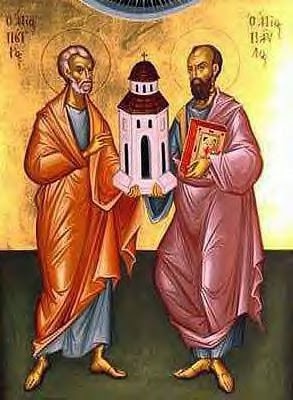
July 6th - Octave Day of SS Peter & Paul


Ancient icon of sts peter & paul


The Octave Day of SS Peter and Paul is of double rite and its liturgical colour is red. The seventh Sunday after Pentecost is commemorated at Vespers, Mattins, Lauds and Mass.

At Vespers yesterday afternoon the antiphons Hoc est praeceptum meum etc, from the Common of Apostles, were sung, doubled, with Pss 109, 110, 111, 112 & 116. The Office hymn was Exsultet caelum laudibus. The versicle and its response, the antiphon on the Magnificat and collect were proper to the Octave Day. After the collect of the Octave Day a commemoration was sung of the Sunday. The Suffrages were omitted as were the Dominical preces at Compline.

At Mattins the invitatory is Regem Apostolorum Dominum, Venite adoremus and the Office hymn is Aeterna Christi munera. In the first nocturn the antiphons In omnem terram etc are sung, doubled, with Pss. 18, 33 & 44. The lessons are from the Sunday and are the the lessons are a continuation of the Second Book of the Kings. The lessons are the same as in modern editions of the Breviary. The responsories in all three nocturns are from the Common of Apostles. In the second nocturn the antiphons Principes populorum etc are sung, doubled, with Pss. 46, 60 and 63 and the lessons are from a sermon of St. Chrysostom. These are the same as those found in the later editions. In the third nocturn the antiphons Exaltabuntur etc are sung, doubled, with Pss. 74, 96 & 98. The homily is from St. Jerome on St. Matthew's Gospel. Again these are the same as those found in the post-Clementine editions. Today the eighth and ninth lessons are read together to form an extended eighth lesson and the ninth lesson is formed from the three lessons given for the homily of the seventh Sunday after Pentecost. These are from St. Hiliary on St. Matthew's Gospel. These lessons are the same as in the post-Clementine editions. The Te Deum is sung.

At Lauds the antiphons Hoc est praeceptum meum etc are sung, doubled, with Pss. 92, 99, 62-66, Benedicite, 148-149-150. The Office hymn is Exsultet caelum laudibus. After the collect of the feast a commemoration of the Sunday is sung. The Suffrages are omitted.

At Prime and the Hours the antiphons from Lauds are sung in the usual order. At Prime, Pss. 53, 188(i) & 118(ii), the lectio brevis is Ibant Apostoli etc.

Mass is sung after Terce. The Gloria is sung, the second collect is of the Sunday, the Creed is sung, the preface is of the Apostles and the last Gospel is of the Sunday.

At second Vespers the antiphons Juravit Dominus etc, from the Common are sung, doubled, with psalms 109, 112, 115, 125 and 138. The Office hymn is Aeterna Christ munera. After the collect of the Octave Day a commemoration of the Sunday is sung. The Suffrages are omitted as are the Dominical preces at Compline.

Icon: Wikipedia, Public domain, via Wikimedia Commons

Sunday, 12 July 2026

June 29th - SS Peter & Paul Apostles


The feast of the Apostles SS Peter and Paul is a double feast with an Octave. The liturgical colour of the feast, and Octave, is red. The sixth Sunday after Pentecost is commemorated in the Office and at Mass.

At Vespers yesterday afternoon the antiphons Petrus et Joannes etc were sung, doubled, with Pss. 109, 110, 111, 112 and 116. The Office hymn was Aurea luce. After the collect of the feast a commemoration was sung of the Sunday. The Suffrages were omitted as were the Dominical preces at Compline.

At Mattins the invitatory is Regem Apostolorum Dominum, Venite adoremus and the Office hymn is Aeterna Christe munera. In the first nocturn the antiphons In omnem terram etc are sung, doubled, with Pss. 18, 33 and 44. The lessons are taken from the Acts of the Apostles. These are identical to those found in the post-Clementine editions. In the second nocturn the antiphons Principes populorum etc are sung, doubled, with Pss. 46, 60 & 63 and the lessons are from a sermon of St. Leo. These lessons are considerably longer than those found in the later editions. In the third nocturn the antiphons Exaltabuntur etc are sung, again doubled, with Pss. 74, 96 & 98. The homily is from St. Jerome on St. Matthew's Gospel. Again the text of these lessons is considerably longer than that found in the later books and the text of the ninth lesson is entirely absent from them. Today the eighth and ninth lessons of the feast are read together to form the eighth lesson of the day and the ninth lesson is formed of the three lessons appointed for the third nocturn of the Sunday. The lessons for the Sunday are from a homily from St. Ambrose on St. Mark's Gospel. The seventh lesson (of the Sunday) includes the first sentence (Consequens igitur... a jejunio liberaret) from the modern eighth lesson. In the Tridentine Breviary the eighth lesson thus begins Itaque nemo and continues with most of the modern ninth lesson until ...sed nec adhuc quidem potestis. The ninth lesson begins In modum lactis but most of its text is not found in the modern books. The Te Deum is sung.

At Lauds the antiphons Petrus et Joannes etc are sung, doubled, with Pss. 92, 99, 62-66, Benedicite, 148-149-150. The Office hymn is Jam bone pastor Petre. After the collect of the feast a commemoration of the Sunday is sung. The Suffrages are omitted.

At Prime, Pss. 53, 118(i) & 118(ii), and the Hours the antiphons of the feast are sung in the usual order. At Prime the lectio brevis is proper to the feast, Et Petrus etc.

Mass is sung after Terce. The Gloria is sung, the second collect is of the Sunday, the Creed is sung, the preface is of the Apostles and the last Gospel is of the Sunday.

At second Vespers the antiphons Juravit Dominus etc, from the Common, are sung with Pss. 109, 112, 115, 125 and 138. The Office hymn is Aurea luce. After the collect of the feast a commemoration of the Sunday is sung. The Suffrages are omitted as are the Dominical preces at Compline.

Sunday, 5 July 2026

June 22nd - V Sunday after Pentecost

The fifth Sunday after Pentecost is of semi-double rite and its liturgical colour is green.

At Vespers yesterday afternoon the antiphons and psalms of Saturday, Pss. 143, 144, 145, 146 & 147, were sung. The chapter was O Altitudo and the Office hymn was O lux beata Trinitas. After the collect of the Sunday a commemoration of St Paulinus was sung followed by the Suffrages of the BVM Sancta Maria succurre etc, the Apostles Petrus Apostolus etc, of the Patron and, lastly, for peace Da pacem Domine etc. At Compline the Dominical preces were sung.

At Mattins the invitatory is Adoremus Dominum and the Office hymn Nocte surgentes. In the first nocturn (Pss. 1, 2, 3, 6, 7, 8, 9, 10, 11, 12, 13 & 14) the lessons are the Incipit of the Second Book of the Kings. These are identical to the lessons found in the post-Clementine editions. In the second nocturn (Pss. 15, 16 & 17) the lessons are taken from St. Gregory's Book on Morals. The fifth lesson is slightly longer and the sixth lesson considerably longer than those found in the later editions. In the third nocturn (Pss. 18, 19 & 20) the homily is from St. Augustine on St. Matthew's Gospel. The Gospel fragment has the additional words Amen dico vobis. The lessons, from the ninth chapter of the first book on the LORD's Sermon on the Mount, are all longer than those found in the later books. Today the eighth and ninth lessons are read as to to form the eighth lesson of the day and the ninth lesson is formed of the two lessons given in the Sanctorale for St. Paulinus. The Te Deum is sung.

At Lauds the Dominical psalms, Pss. 92, 99, 62-66, Benedicite & 148-49-150, are sung. The Office hymn is Ecce jam noctis. After the collect of the Sunday a commemoration of St. Paulinus is sung followed by the Suffrages of the BVM Santa Maria succurre etc, the Apostles Gloriosi principes etc, of the Patron and lastly for peace Da pacem Domine etc.

At Prime, Pss. 53, 117, 118(i) & 118(ii) both Quicumque and the Dominical preces are sung.

Mass is sung after Terce. The Gloriais sung, the second collect is of St. Paulinus, the third collect is A cunctis nos. The Creed and the common preface are sung.

Vespers are of the Sunday, Pss. 109, 110, 111, 112 & 113, and the Office hymn is Lucis creator optime. After the collect of the Sunday the Suffrages of the BVM Sancta Maria succurre etc, the Apostles Petrus Apostolus etc, of the Patron and lastly for peace Da pacem Domine are sung. At Compline the Dominical preces are sung.

Art: Jerome Nadal

Sunday, 28 June 2026

June 15th - IV Sunday after Pentecost


The fourth Sunday after Pentecost is of semi-double rite and its liturgical colour, from Mattins onwards this year, is green.

Yesterday afternoon second Vespers of the feast of St. Basil were sung. The antiphons Ecce sacerdos magnus etc were sung, doubled, with Pss. 109, 110, 111, 112 & 116. The Office hymn was Iste confessor. After the collect of the feast commemorations were sung of the Sunday and of SS Vitus, Modestus and Crescentia. The Suffrages were omitted due to the occurring double feast as were the Dominical preces at Compline.

At Mattins the invitatory is Adoremus Dominum and the Office hymn is Nocte surgentes. In the first nocturn (Pss. 1, 2, 3, 6, 7, 8, 9, 10, 11, 12, 13 & 14) are sung and the lessons continue to be taken from the First Book of the Kings. The first lesson is the same as found in modern recensions, the second lesson continues David autem...grandaevus inter viros (from the modern third lesson) and the third lesson begins Abierunt autem ... quadraginta diebus. However, it then continues Dixit autem... sicut Isai - from v. 17 through to half of v. 20. The responsories are Praeparate corda vestra etc. In the second nocturn (Pss. 15, 16 & 17) the lessons are taken from a Sermon of St. Augustine. These are the same as found in the post Clementine editions. In the third nocturn (Pss. 18, 19 & 20) the homily is from St. Ambrose on St. Luke's Gospel, but the lessons are longer than in modern editions. Today the eighth and ninth lessons are read as one to form the eighth lesson of the day and the ninth lesson is formed of the two lessons given in the Sanctorale for the feast of SS Vitus, Modestus and Crescentia. The Te Deum is sung.

At Lauds, Pss. 92, 99, 62-66, Benedicite & 148-49-150, the Office hymn is Ecce jam noctis. After the collect of the Sunday a commemoration is sung of SS Vitus, Modestus and Crescentia followed by the Suffrages of the BVM Santa Maria succurre etc, the Apostles Gloriosi principes etc, and of the Patron and lastly for peace Da pacem Domine etc .

At Prime, Pss. 53, 117, 118(i) & 118(ii), both Quicumque and the Dominical preces are sung.

Mass is sung after Terce. The Gloria is sung, the second collect is of SS Vitus, Modestus and Cresentia, the third collect is A cunctis. The Creed and the common preface are sung.

Vespers are of the Sunday, Pss.109, 110, 111, 113 & 113. The Office hymn is Lucis creator. After the collect of the Sunday the Suffrages of the BVM Sancta Maria succurre etc, the Apostles Petrus Apostolus etc, of the Patron and, lastly, for peace Da pacem Domine etc are sung. At Compline the Dominical preces are sung.

Art: Jerome Nadal

Sunday, 21 June 2026

June 8th - III Sunday after Pentecost


The third Sunday after Pentecost is of semi-double rite and its liturgical colour is green.

At Vespers yesterday afternoon the antiphons and psalms of Saturday, Pss. 143, 144, 145, 146 & 147, were sung. The chapter was O Altitudo and the Office hymn was O lux beata Trinitas. After the collect of the Sunday the Suffrages of the BVM Sancta Maria succurre etc, the Apostles Petrus Apostolus etc, of the Patron and, lastly, for peace Da pacem Domine etc were sung. At Compline the Dominical preces were sung.

At Mattins the invitatory is Adoremus Dominum and the Office hymn is Nocte surgentes. In the first nocturn (Pss. 1, 2, 3, 6, 7, 8, 9, 10, 11, 12, 13 & 14) the lessons are taken from the First Book of the Kings. These are the same as in modern recensions, the responsories are Praeparate corda vestra etc. In the second nocturn (Pss. 15, 16 & 17) the lessons are taken from the Exposition on the book of Kings of St. Gregory. In the third nocturn (Pss. 18, 19 & 20) the homily (found near the end of the Breviary) is from St. Augustine but the lessons are longer than in the post-Clementine books. The seventh lesson is consists of text which forms the seventh and eighth lessons in the later books. The eighth lesson is several sentences longer than the modern ninth lesson and the ninth lesson is not found in the later books. The Te Deum is sung.

At Lauds the Dominical psalms, Pss. 92, 99, 62-66, Benedicite & 148-49-150, are sung. The Office hymn is Ecce jam noctis. After the collect of the Sunday the Suffrages of the BVM Sancta Maria succurre etc, the Apostles Gloriosi principes etc, of the Patron and lastly for peace Da pacem Domine etc are sung.

At Prime, Pss. 53, 117, 118(i) & 118(ii), both Quicumque and the Dominical preces are sung.

Mass is sung after Terce. The Gloria is sung, the second collect is A cunctis, the third collect is chosen by the Dean or Rector. The Creed and the commopn preface are sung.

Vespers are of the Sunday, Pss. 109, 110, 111, 112 & 113, the Office hymn is Lucis creator. After the collect of the Sunday a commemoration of the following feast of SS Primus and Felician is sung followed by the Suffrages of the BVM, SS Peter and Paul, the Patron and for peace. At Compline the Domincal preces are sung.

Art: Jerome Nadal

Sunday, 14 June 2026

June 1st - Sunday within the Octave of Corpus Christi

Sunday within the Octave of Corpus Christi, the second Sunday after Pentecost, is of semi-double rite. As with all Sundays within Octaves the liturgical colour is of the Octave which, in this case, is white.

At Vespers yesterday afternoon the antiphons Sacerdos in aeternum etc were sung, not doubled, with Pss.109, 110, 115, 127 & 147 as on the feast of Corpus Christi. The chapter was of the Sunday, the Office hymn Pange lingua and versicle and response as on the feast. The antiphon on the Magnificat was proper to the Sunday along with the collect. After the collect of the Sunday a commemoration of the Octvave was sung. At Compline Te lucis was sung with the Doxlogy Gloria tibi Domine etc.

At Mattins the invitatory is Christum Regem adoremus dominantem Gentibus: Qui se manducantibus dat spiritus pinguedinem, as on the feast. The Office hymn is Sacris solemnis. The antiphons and psalms are as on the feast of Corpus Christi. In the first nocturn the antiphons Fructum salutiferum etc are sung with Pss. 1, 4 & 15. The lessons in the first nocturn they are taken from the First Book of Kings. The first lesson continues with the beginning of the second lesson found in modern editions Misit ergo populus...Ophni et Phinees. The responsories are as on the feast. The second lesson begins Cumque venisset arca...and includes what is now the third lesson, ending ...Ophni et Phinees. The third lesson, not present in the modern editions, begins at verse 12 of the fourth chapter Currens autem vir... and continues until the middle of the eighteenth verse ...cirvicibus mortuus est. In the second nocturn the antiphons Memor sit Dominus etc with Pss. 19, 22 & 41. The lessons are taken from a sermon of St. Chrysostom to the people of Antioch. The fourth lesson is longer than in modern editions beginning, at the same point, with Quoniam Verbum dicit... but continuing until ...proponitur indigne sumentibus (appoximately half-way through the fifth lesson in modern edtions). The fifth lesson begins Considera quantum adverus (Considera being replaced by Cogita in modern editions) and continues until ..sumus unum Christi corpus, et una caro. The sixth lesson begins Quis loquetur potentias (halfway through L6 in the modern books) and continues for several more sentences of the sermon ending with ..qui vero sanctificat ea et immutat, ipse est. In the third nocturn the homily in is from St. Gregory on St. Luke's Gospel. Again the lessons are longer than in the modern editions so that the ninth lesson Sed superna...quod praesto est, perat is not found in the later books. The Te Deum is sung.

At Lauds the antiphons of the feast Sapientia etc are sung, not doubled, with Pss.92, 99, 62-66, Benedicite & 148-149-150. The chapter is of the Sunday, the hymn as on the feast, Verbum supernum. The antiphon on the Benedictus and collect are of the Sunday. After the collect of the Sunday a commemoration of the Octave is sung.

At the Little Hours the hymns are sung to the same tone as on the feast of the Nativity of the LORD with the with the Doxology Gloria tibi Dominieetc. At Prime, Pss. 53, 118(i) & 118(ii), the versicle in the short responsory is Qui natus es for the feast and Octave, the short lesson is Filioli mei, of the Sunday. Quicumque is not sung as the Office is festal.

Mass is sung after Terce. The Gloria is sung, the second collect is of the Octave. There is no third collect. The Creed is sung and the preface is that of the Nativity.

At Vespers the antiphons Sacerdos in aeternum etc are sung, not doubled, with Pss. 109, 110, 115, 127 & 147. The Office hymn is Pange lingua. After the collect of the Sunday commemorations are sung of the Octave and of SS Peter & Marcellinus.

Image: Missale Romanum, 1572,  Antwerp

Sunday, 7 June 2026

May 25th - The Most Holy Trinity

The Feast of the Most Holy Trinity is a double feast and its liturgical colour is white. Today is also the first Sunday after Pentecost.

At first Vespers yesterday afternoon the antiphons Gloria tibi Trinitas etc were sung, doubled, with Pss. 109, 110, 111, 112 and 116. The chapter, O altitudo, and hymn, O lux beata Trinitas, will be used at Vespers on Saturdays for all the Sundays after Pentecost when the following Office if of the Sunday. The antiphon on the Magnificat, Gratias tibi, Deus etc, and the collect, Omnipotens, were proper to the feast. After the collect of the feast a commemoration was sung of the first Sunday after Pentecost. After Vespers the antiphon Salve Regina was sung for the first time this year.

At Mattins the invitatory is proper, Deum verum, unum in Trinitate, et Trinitatm in Unitate, Venite adoremus. The Office hymn is Summae Deus clementiae. In the first nocturn the antiphons Adesto unus Deus etc are sung, doubled, with psalms 8, 18 & 23. The lessons are taken from the sixth chapter of the Prophet Isaiah. These are identical to those found in the 'modern' books. In the second nocturn the antiphons Te invocamus etc are sung, doubled, with psalms 46, 47 & 51. The lessons are taken from the Book of Bishop Fulgentius on faith. The fourth lesson continues with Si enim, sicut et Patris...veraciter Trinitas diceretur. The fifth lesson begins Rursus quidem Trinitas...and continues Per hanc unitatem...totus quoque Spiritus Sanctus in Patre et Filio. The sixth lesson begins Nullus horum and continues past the ending found in the 'modern' editions with three more sentences Sicut ergo...est trium personarum divinitas. In the third nocturn the antiphons Caritas Pater est etc are sung, doubled, with psalms 95, 96 & 97. The lessons are from a homily of St. Gregory Nazianzen. These are again slightly longer than those found in the 'modern' editions. The seventh lesson continues Nec extensionem...atque potentiae credimus. The eighth lesson begins Et ideo unum... and continues Sic est Apostolus...per quem omnia et nos per ipsum. The ninth lesson is of the first Sunday after Pentecost, it ends slightly before the version in 'modern' editions with Ego sum panis vivus, qui de caelo descendi? The Te Deum is sung.

At Lauds the antiphons Gloria tibi Trinitas are sung with Pss. 92, 99, 62-66, Benedicite & 148-149-150. The Office hymn is Tu, Trinitatis Unitas. After the collect of the feast commemorations are sung of the first Sunday after Pentecost and of St. Urban.

At Prime, Pss. 53, 118(i) & 118(ii), Quicumque is sung but the Dominical preces are omitted.

Mass is sung after Terce. Before Mass at the sprinkling of lustral water the antiphon Asperges me returns. The Mass is proper, Benedicta sit. The Gloria is sung, the second collect is of the Sunday, the third collect is of St. Urban. The Creed and the common preface are sung and the last Gospel is of the Sunday.

At second Vespers the antiphons Gloria tibi Trinitas etc are sung with Pss. 109, 110, 111, 112 & 113. The chapter is O altitudo and the Office hymn O lux beata Trinitas. After the collect of the feast commemorations are sung of the first Sunday after Pentecost and of St. Eleutherius. At Compline the Dominical preces are omitted.

Sunday, 31 May 2026

May 18th - Dominica in Pentecostes - Pentecost Sunday


The feast of Pentecost is a double feast with an Octave preceded by a Vigil similar to that of Pascha but although the Vigil is celebrated after None, and has six prophecies, followed by the blessing of the font, Litany and Mass of the Vigil the service of Vespers is not integrated into the morning ceremonies. The liturgical colour of the feast and its Octave is red.

At Vespers yesterday afternoon the antiphons Dum complerentur dies Pentecostes etc were sung, doubled, with psalms 109, 110, 111, 112 & 116. The chapter was Dum complerentur dies Pentecostes etc and the Office hymn was Veni, Creator Spiritus. All hymns of Iambic metre have the Doxology Gloria Patri Domino, Natoque, qui a mortuis, Surrexit ac Paraclito, In saeculorum saecula during the Octave. There are no commemorations. The Suffrages are omitted during the Octave as are the Dominical preces.

Mattins for the feast, and Octave, is like Pascha in only having a single nocturn of three psalms and three lessons. The invitatory is Alleluia, Spiritus Domini replevit orbem terrarum, Venite adoremus Alleluia. The Office hymn is Jam Christus aster ascenderat. The antiphons Factus est etc are sung, doubled, with Pss. 47, 67 & 103. The lessons are from a homily of St. Gregory the Great on St. John's Gospel. The lessons are the same as those appearing in the later editions of the Breviary. At Lauds the antiphons, Dum complerentur dies Pentecostes etc, are the same as those at Vespers and are sung, doubled, with psalms 92, 99, 62-66, Benedicite and 148-149-150. The Office hymn is Beata nobis gaudia.

At Prime Pss. 53, 118(i) & 118(ii) are sung under the antiphon Dum complerentur dies Pentecostes. In the short responsory the versicle Qui sedes ad dexteram Patris, alleluia, alleluia is sung. The short lesson is Judaei quoque. At Terce instead of the usual hymn Nunc Sancte nobis the hymn Veni Creator is sung as it was at the third hour the Holy Ghost descended on the Apostles.

At Mass the Gloria is sung and there is a single collect. After the Alleluia the sequence Veni, Sancte Spiritus is sung. The Creed is sung. The preface, Communicantes and Hanc igitur are proper to the feast and used throughout the Octave.

At second Vespers the antiphons Dum complerentur dies Pentecostes etc are sung, doubled, with the Dominical psalms (109, 110, 111, 112 & 113). The versicle and response and antiphon on the Magnificat are proper to second Vespers. There are no commemorations. The feast of St. Pudentiana is omitted this year from the Universal Calendar.

Art: Jerome Nadal.

Sunday, 24 May 2026

May 11th - Sunday within the Octave of the Ascension


Sunday within the Octave of the Ascension is of semi-double rite and its liturgical colour is white. The theme of Thursday's great feast of the Ascension continues with the majority of the texts used today coming from the feast itself.

At Vespers yesterday afternoon the antiphons for the feast, Viri Galilaei etc were sung, not doubled, with the psalms as sung on the feast (Pss. 109, 110, 111, 112 & 116). The chapter was of the Sunday, the Office hymn for the Ascension, Jesu nostra redemptio, and the antiphon on the Magnificat and collect were both proper to the Sunday. After the collect of the Sunday a commemoration was sung of the Octave. At Compline Te lucis was sung with the Ascension Doxology, Gloria tibi Domine, Qui scandis super sidera, Cum Patre et Sancto Spiritu, In sempiterna saecula. The Dominical preces were omitted because of the Octave.

At Mattins the invitatory is Alleluia, Christum Dominum ascendentem in coelum, Venite adoremus. The Office hymn at Mattins is Aeterne Rex altissime. In the first nocturn the antiphons Elevata est etc are sung with Pss. 8, 10 & 18. The lessons are the Incipit of the First Epistle of St. John and the responsories are of the feast. The lessons are the same as those found in post-Clementine editions of the Breviary. In the second nocturn the antiphons Exaltare Domine etc are sung with Pss. 20, 29 & 46. The lessons are taken from a sermon on the Ascension by St. Augustine, These are the same as those in the modern editions. In the third nocturn the antiphons Nimis exaltatus etc are sung with Pss. 96, 98 & 102. The homily on the Gospel from John is also from St. Augustine, these are the same as those in the modern editions. The Te Deum is sung.

At Lauds the antiphons Viri Galilaei etc are sung with Pss. 92, 99, 62-66, Benedicite & 148-149-150. The chapter is of the Sunday, the Office hymn is of the Ascension Jesu nostra redemptio. The antiphon on the Benedictus, versicle & respond and collect are proper to the Sunday. After the collect of the Sunday a commemoration of the Octave is sung.

At the Little Hours the hymns are sung with the Doxology of the Ascension. At Prime, Pss. 53, 118(i), 118(ii) are sung and the short lesson is Si quis loquitur. The Dominical preces are omitted due to the Octave.

Mass is sung after Terce. The Gloria is sung, the second collect is of the Octave. Today there is no third collect. The Creed is sung and the preface and communicantes are of the Octave.

At Vespers the antiphons Viri Galilaei are sung, not doubled, with the psalms of the feast are sung. The chapter is of the Sunday, the Office hymn Jesu nostra redemptio. The antiphon on the Magnificat and collect are of the Sunday. After the collect of the Sunday commemorations are sung of the Octave and of SS Nereus, Achilleus, Domitilla and Pancras. At Compline the Dominical preces are omitted due to the Octave.
Art: Jerome Nadal

Sunday, 17 May 2026

May 4th - Fifth Sunday after Pascha


The fifth Sunday after Pascha is of semi-double rite and its liturgical colour, from Mattins this year, is white. The Gospel pericopes from St. John's Gospel describe how the LORD tells His disciples to ask for anything in His name after He has ascended to the Father.

Yesterday afternoon second Vespers of the feast of the Invention of the Holy Cross were sung. The antiphons Helena Constantini mater etc (which are absent from the modern editions) were sung with Pss. 109, 110, 111, 112 & 116. The Office hymn was Vexilla Regis prodeunt, sung with the Paschaltide stroph in the sixth verse. After the collect of the feast commemorations were sung of the Sunday and of St. Monica. At Compline the Dominical preces were omitted due to the double feast.

At Mattins the invitatory is Surrexit Dominus vere Alleluia and the Office hymn is O Rex aeterne Domine. In the first nocturn psalms 1, 2, 3, 6, 7, 8, 9, 10, 11, 12, 13 & 14 are sung under a single antiphon Alleluia, Lapis revolutus etc., the lessons are the Incipit of the first Epistle of St. Peter. The lessons are the same as in the post-Clementine editions. In the second nocturn (Pss. 15, 16 & 17) the lessons are taken from the book of St. Ambrose on faith in the Resurrection. These too are the same as in modern recensions. In the third nocturn (Pss. 18, 19 & 20) the homily is from St. Augustine. The seventh lesson is longer than in modern recensions including Unde qui hoc... nomine non petit from the 'modern' eighth lesson (sharp eyed readers will notice the non). The eighth lesson runs Qui vero quod est de illo ... proculdubio tunc erit plenum, i.e. continuing into half of what is now the ninth lesson. The ninth lesson begins Quidquid ergo petitur and continues for several more sentences absent from the post-Clementine books. Today the eighth and ninth lessons are read as one and the ninth lesson is formed of the two historical lessons given for St. Monica. The Te Deum is sung.

At Lauds Pss 92, 99 and 62-66 are sung under a single antiphon, the ancient nine-fold Alleluia. Benedicite is sung with the antiphon Surrexit Christus etc, and Pss. 148, 149 and 150 are sung under a single antiphon, a four-fold Alleluia as on previous Sundays. The Office hymn is Aurora lucis rutilat. After the collect of the Sunday a commemoration is sung of St. Monica followed by the Paschal Commemoration of the Cross.

At the Hours the hyns have the Paschal Doxology and the psalms are sung under an antiphon consisting of a four-fold Alleluia. At Prime, Pss. 53, 117, 118(i), 118(ii) both Quicumque and the Dominical preces are sung.

Mass is sung after Terce. The Gloria is sung, the second collect is of St. Monica, the third collect is Concede nos. The Creed is sung and the preface is of Paschaltide.

Vespers are of the Sunday, with Pss. 109, 110, 111, 112 & 113 sung under a single antiphon. The Office hymn is Ad coenam Agni providi. After the collect of the Sunday the Paschal Commmemoration of the Cross is sung. At Compline the Dominical preces are sung.

Art: Jerome Nadal