Sunday, 19 July 2020

July 6th - Octave Day of SS Peter & Paul

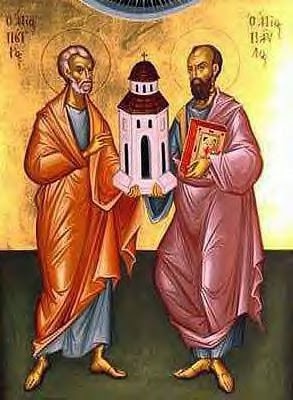
Ancient icon of sts peter & paul

The Octave Day of SS Peter and Paul is of double rite and its liturgical colour is red. Today is also the sixth Sunday after Pentecost and the Sunday is commemorated at Vespers, Mattins, Lauds and Mass.

At Vespers yesterday afternoon the antiphons Hoc est praeceptum meum etc, from the Common of Apostles, were sung, doubled, with psalms 109, 110, 111, 112 & 116. The Office hymn was Exsultet caelum laudibus. The versicle and its response, the antiphon on the Magnificat and collect were proper to the Octave Day. After the collect of the Octave Day a commemoration was sung of the Sunday. The Suffrages were omitted as were the Dominical preces at Compline.

At Mattins the invitatory is Regem Apostolorum Dominum, Venite adoremus and the Office hymn is Aeterna Christi munera. In the first nocturn the antiphons In omnem terram etc are sung with psalms 18, 33 & 44. The lessons are from the Sunday and are the the lessons are a continuation of the Second Book of the Kings. The lessons are the same as in modern editions of the Breviary. The responsories in all three nocturns are from the Common of Apostles. In the second nocturn the antiphons Principes populorum etc are sung with psalms 46, 60 and 63 and the lessons are from a sermon of St. Chrysostom. These are the same as those found in the later editions. In the third nocturn the antiphons Exaltabuntur etc are sung with psalms 74, 96 & 98. The homily is from St. Jerome on St. Matthew's Gospel. Again these are the same as those found in the post-Clementine editions. Today the eighth and ninth lessons are read together to form an extended eighth lesson and the ninth lesson is formed from the three lessons given for the homily of the sixth Sunday after Pentecost. These are taken from a homily from St. Ambrose on St. Mark's Gospel. The seventh lesson (of the Sunday) includes the first sentence (Consequens igitur... a jejunio liberaret) from the modern eighth lesson (of the Sunday). In the Tridentine Breviary the eighth lesson thus begins Itaque nemo and continues with most of the modern ninth lesson until ...sed nec adhuc quidem potestis. The ninth lesson (of the Sunday) begins In modum lactis but most of its text is not found in the modern books. The Te Deum is sung.

At Lauds the antiphons Hoc est praeceptum meum etc are sung, doubled, with the Dominical psalms 92, 99, 62-66, Benedicite, 148-149-150. The Office hymn is Exsultet caelum laudibus. After the collect of the feast a commemoration of the Sunday is sung. The Suffrages are omitted.

At Prime and the Hours the antiphons from Lauds are sung in the usual order. At Prime the lectio brevis is Ibant Apostoli etc.

Mass is sung after Terce. The Gloria is sung, the second collect is of the Sunday, the Creed is sung, the preface is of the Apostles and the last Gospel is of the Sunday.

At second Vespers the antiphons Juravit Dominus etc, from the Common are sung with psalms 109, 112, 115, 125 and 138. The Office hymn is Aeterna Christ munera. After the collect of the Octave Day a commemoration of the Sunday is sung. The Suffrages are omitted as are the Dominical preces at Compline.

Icon: Wikipedia

Sunday, 12 July 2020

June 29th - SS Peter & Paul Apostles


The feast of the Apostles SS Peter and Paul is a double feast with an Octave. The liturgical colour of the feast, and Octave, is red. The fifth Sunday after Pentecost is commemorated in the Office and at Mass.

At Vespers yesterday afternoon the antiphons Petrus et Joannes etc were sung, doubled, with psalms 109, 110, 111, 112 and 116. The Office hymn was Aurea luce. After the collect of the feast a commemoration was sung of the Sunday. The Suffrages were omitted as were the Dominical preces at Compline.

At Mattins the invitatory is Regem Apostolorum Dominum, Venite adoremus and the Office hymn is Aeterna Christe munera. In the first nocturn the antiphons In omnem terram etc are sung, doubled, with psalms 18, 33 and 44. The lessons are taken from the Acts of the Apostles. These are identical to those found in the post-Clementine editions. In the second nocturn the antiphons Principes populorum etc are sung, doubled, with psalms 46, 60 and 63 and the lessons are from a sermon of St. Leo. These lessons are considerably longer than those found in the later editions. In the third nocturn the antiphons Exaltabuntur etc are sung, again doubled, with psalms 74, 96 & 98. The homily is from St. Jerome on St. Matthew's Gospel. Again the text of these lessons is considerably longer than that found in the later books and the text of the ninth lesson is entirely absent from them. Today the eighth and ninth lessons of the feast are read together to form the eighth lesson of the day and the ninth lesson is formed of the three lessons appointed for the third nocturn of the Sunday. The lessons for the Sunday are from a homily of St. Augustine on St. Matthew's Gospel. The Gospel fragment has the additional words Amen dico vobis. The lessons, from the ninth chapter of the first book on the LORD's Sermon on the Mount, are all longer than those found in the later books. The Te Deum is sung. At Lauds the antiphons Petrus et Joannes etc are sung, doubled, with the Dominical psalms 92, 99, 62-66, Benedicite, 148-149-150. The Office hymn is Jam bone pastor Petre. After the collect of the feast a commemoration of the Sunday is sung. The Suffrages are omitted.

At Prime and the Hours the antiphons of the feast are sung in the usual order. At Prime the lectio brevis is proper to the feast, Et Petrus etc.

Mass is sung after Terce. The Gloria is sung, the second collect is of the Sunday, the Creed is sung,the preface is of the Apostles and the last Gospel is of the Sunday.

At second Vespers the antiphons Juravit Dominus etc, from the Common are sung with psalms 109, 112, 115, 125 and 138. The Office hymn is Aurea luce. After the collect of the feast a commemoration of the Sunday is sung. The Suffrages are omitted as are the Dominical preces at Compline.

Sunday, 5 July 2020

June 22nd - IV Sunday after Pentecost


The fourth Sunday after Pentecost is of semi-double rite and its liturgical colour is green.

At Vespers yesterday afternoon the antiphons and psalms of Vespers for Saturday (Pss. 143, 144, 145, 146 & 147) were sung. The chapter was O Altitudo and the Office hymn was O lux beata Trinitas. After the collect of the Sunday a commemoration was sung of St. Paulinus followed by the Suffrages of the BVM Sancta Maria succurre etc, the Apostles Petrus Apostolus etc, of the Patron and lastly for peace Da pacem Domine. At Compline the Dominical preces were sung.

At Mattins the invitatory is Adoremus Dominum and the Office hymn is Nocte surgentes. In the first nocturn (Pss. 1, 2, 3, 6, 7, 8, 9, 10, 11, 12, 13 & 14) are sung and the lessons continue to be taken from the First Book of the Kings. The first lesson is the same as found in modern recensions, the second lesson continues David autem...grandaevus inter viros (from the modern third lesson) and the third lesson begins Abierunt autem ... quadraginta diebus. However, it then continues Dixit autem... sicut Isai - from v. 17 through to half of v. 20. The responsories are Praeparate corda vestra etc. In the second nocturn (Pss. 15, 16 & 17) the lessons are taken from a Sermon of St. Augustine. These are the same as found in the post Clementine editions. In the third nocturn (Pss. 18, 19 & 20) the homily is from St. Ambrose on St. Luke's Gospel, but the lessons are longer than in modern editions. Today the eighth and ninth lessons are read together to form and extended eighth lesson of the Sunday and the ninth lesson is formed of the two lessons given in the Sanctorale for St. Paulinus. The Te Deum is sung.

At Lauds the Dominical psalms (Pss. 92, 99, 62-66, Benedicite & 148-49-150) are sung. The Office hymn is Ecce jam noctis. After the collect of the Sunday a commemoration is sung of St. Paulinus followed by the Suffrages of the BVM Sancta Maria succurre etc, the Apostles Gloriosi principes etc, of the Patron and lastly for peace Da pacem Domine .

At Prime Pss. 53, 117, 118i & 118ii are sung as are Quicumque and the Dominical preces.

Mass is sung after Terce. The Gloria is sung, the second collect is of St. Paulinus, the third collect is A cunctis. The Credo is sung and the Common Preface is sung.

Vespers are of the Sunday, with psalms 109, 110, 111, 112 & 113. The Office hymn is Lucis creator. After the collect of the Sunday the Suffrages of the BVM Sancta Maria succurre etc, the Apostles Petrus Apostolus etc, of the Patron and lastly for peace Da pacem Domine etc are sung. At Compline the Domincal preces are sung.


Art: Jerome Nadal

Sunday, 28 June 2020

June 15th - III Sunday after Pentecost


The third Sunday after Pentecost is of semi-double rite and its liturgical colour, from Mattins, is green.

Vespers yesterday afternoon were second Vespers of the feast of St. Basil. The antiphons Ecce sacerdos magnus etc were sung, doubled, with psalms 109, 110, 111, 112 & 116. The Office hymn was Iste confessor. After the collect of the feast commemorations were sung of the Sunday and of SS Vitus, Modestus and Crescentia. The Suffrages were omitted due to the occurring double feast as were the Dominical preces at Compline.

At Mattins the invitatory is Adoremus Dominum and the Office hymn is Nocte surgentes. In the first nocturn (Pss. 1, 2, 3, 6, 7, 8, 9, 10, 11, 12, 13 & 14) the lessons are taken from the First Book of the Kings. These are the same as in modern recensions, the responsories are Praeparate corda vestra etc. In the second nocturn (Pss. 15, 16 & 17) the lessons are taken from the Exposition on the book of Kings of St. Gregory. In the third nocturn (Pss. 18, 19 & 20) the homily (found near the end of the Breviary) is from St. Augustine but the lessons are longer than in the post-Clementine books. The seventh lesson is consists of text which forms the seventh and eighth lessons in the later books. The eighth lesson is several sentences longer than the modern ninth lesson and the ninth lesson is not found in the later books. Today the text of the eighth and ninth lessons are joined together to form an extended eighth lesson and the ninth lesson is formed from the three lessons appointed for the feast of SS SS Vitus, Modestus and Crescentia. The Te Deum is sung.

At Lauds the Dominical psalms (Pss. 92, 99, 62-66, Benedicite & 148-49-150) are sung. The Office hymn is Ecce jam noctis. After the collect of the Sunday a commemoration is sung of SS Vitus, Modestus and Crescentia followed by the Suffrages of the BVM Sancta Maria succurre etc, the Apostles Gloriosi principes etc, of the Patron and lastly for peace Da pacem Domine .

At Prime (Pss. 117, 118i & 118ii) Quicumque is sung as are the Dominical preces.

Mass is sung after Terce. The Gloria is sung, the second collect is of SS SS Vitus, Modestus and Crescentia, the third collect is A cunctis. The Credo is sung and the Common Preface is sung.

Vespers are of the Sunday, with psalms (109, 110, 111, 112 & 113). The Office hymn is Lucis creator. After the collect of the Sunday the Suffrages of the BVM Sancta Maria succurre etc, the Apostles Petrus Apostolus etc, of the Patron and lastly for peace Da pacem Domine etc are sung. At Compline the Domincal preces are sung.

Art: Jerome Nadal

Sunday, 21 June 2020

June 8th - Sunday within the Octave of Corpus Christi - Second Sunday after Pentecost

Sunday within the Octave of Corpus Christi, the second Sunday after Pentecost, is of semi-double rite. As with all Sundays celebrated within Octaves the liturgical colour is of the Octave which, in this case, is white.

At Vespers yesterday afternoon the antiphons of the feast, Sacerdos in aeternum etc, were sung, not doubled, with psalms 109, 110, 115, 127 & 147. The chapter was of the Sunday, the hymn, versicle and response as on the feast. The antiphon on the Magnificat was proper to the Sunday along with the collect. After the collect of the Sunday a commemoration of the Octave was sung. The Suffrages were omitted being within an Octave.  At Compline Te lucis was sung with the Doxlogy Gloria tibi Domine etc and the Dominical preces were omitted.

At Mattins the invitatory is Christum Regem adoremus dominantem Gentibus: Qui se manducantibus dat spiritus pinguedinem, as on the feast. The Office hymn is Sacris solemnis. The antiphons and psalms are as on the feast of Corpus Christi. In the first nocturn the antiphons Fructum salutiferum etc are sung with Pss. 1, 4 & 15. The lessons in the first nocturn they are taken from the First Book of Kings. The first lesson continues with the beginning of the second lesson found in modern editions Misit ergo populus...Ophni et Phinees. The responsories are as on the feast. The second lesson begins Cumque venisset arca...and includes what is now the third lesson, ending ...Ophni et Phinees. The third lesson, not present in the modern editions, begins at verse 12 of the fourth chapter Currens autem vir... and continues until the middle of the eighteenth verse ...cirvicibus mortuus est. In the second nocturn the antiphons Memor sit Dominus etc with Pss. 19, 22 & 41. The lessons are taken from a sermon of St. Chrysostom to the people of Antioch. The fourth lesson is longer than in modern editions beginning, at the same point, with Quoniam Verbum dicit... but continuing until ...proponitur indigne sumentibus (appoximately half-way through the fifth lesson in modern editions). The fifth lesson begins Considera quantum adverus (Considera being replaced by Cogita in modern editions) and continues until ..sumus unum Christi corpus, et una caro. The sixth lesson begins Quis loquetur potentias (halfway through L.6 in the modern books) and continues for several more sentences of the sermon ending with ..qui vero sanctificat ea et immutat, ipse est. In the third nocturn the homily in is from St. Gregory on St. Luke's Gospel. Again the lessons are longer than in the modern editions so that the ninth lesson Sed superna...quod praesto est, perat is not found in the later books. The Te Deum is sung.

At Lauds the antiphons are those sung on the feast of Corpus Christi, Sapientia etc but they are not doubled. These are sung with Psalms 92, 99, 62-66, Benedicite and 148-149-150. The chapter is of the Sunday, the hymn as on the feast, Verbum supernum. The antiphon on the Benedictus and collect are of the Sunday. After the collect of the Sunday a commemoration of the Octave is sung. The Suffrages are omitted.

At the Little Hours the hymns are sung to the same tone as on the feast of the Nativity of the LORD with the with the Doxology Gloria tibi Dominieetc. At Prime the festal psalms are sung (Pss. 53, 118i & 118ii), the versicle in the short responsory is Qui natus es for the feast and Octave, the short lesson is Filioli mei, of the Sunday.  Quicumque is not sung as the Office is festal, nor are the Dominical preces.

Mass is sung after Terce. The Gloria is sung, the second collect is of the Octave. Being within an Octave there is no third collect. The Creed is sung and the preface is that of the Nativity.

At Vespers the antiphons Sacerdos in aeternum etc are again sung, not doubled, with psalms 109, 110, 115, 127 & 147. The Office hymn is Pange lingua. After the collect of the Sunday commemorations are sung of the Octave and of SS Primus & Felician.  The Suffrages are omitted as are the Dominical preces at Compline.

Art: Jerome Nadal

Sunday, 14 June 2020

June 1st - Trinity Sunday


The feast of the Most Holy Trinity is a double feast and its liturgical colour is white. Today is also the first Sunday after Pentecost and the Sunday is commemorated at Mass and in the Office. The Octave of Pentecost ended yesterday with the celebration of the Ember Saturday Mass after None.

At first Vespers yesterday afternoon the antiphons Gloria tibi Trinitas etc were sung, doubled, with Pss. 109, 110, 111, 112 and 116. The chapter, O altitudo, and hymn, O lux beata Trinitas, will both be used at Vespers on Saturdays for all the Sundays after Pentecost when the following Office is of the Sunday. The antiphon on the Magnificat, Gratias tibi, Deus etc, and the collect, Omnipotens, were proper to the feast. After the collect of the feast a commemoration was sung of the first Sunday after Pentecost. After Vespers the antiphon Salve Regina was sung for the first time this year

At Mattins the invitatory is Deum verum, unum in Trinitate, et Trinitatm in Unitate, Venite adoremus and the Office hymn is Summae Deus clementiae. In the first nocturn the antiphons Adesto unus Deus etc are sung with psalms 8, 18 & 23. The lessons are taken from the sixth chapter of the Prophet Isaiah. These are identical to those found in the 'modern' books. In the second nocturn the antiphons Te invocamus etc are sung with psalms 46, 47 & 51. The lessons are taken from the Book of Bishop Fulgentius on faith. The fourth lesson continues with Si enim, sicut et Patris...veraciter Trinitas diceretur. The fifth lesson begins Rursus quidem Trinitas...and continues Per hanc unitatem...totus quoque Spiritus Sanctus in Patre et Filio. The sixth lesson begins Nullus horum and continues past the ending found in the 'modern' editions with three more sentences Sicut ergo...est trium personarum divinitas. In the third nocturn the antiphons Caritas Pater est etc are sung with psalms 95, 96 & 97. The lessons are from a homily of St. Gregory Nazianzen. These are again slightly longer than those found in the later editions. The seventh lesson continues Nec extensionem...atque potentiae credimus. The eighth lesson begins Et ideo unum... and continues Sic est Apostolus...per quem omnia et nos per ipsum. The ninth lesson is of the first Sunday after Pentecost, it ends slightly before the version in 'modern' editions with Ego sum panis vivus, qui de caelo descendi? The Te Deum is sung.

At Lauds the antiphons Gloria tibi Trinitas are sung with the Dominical psalms 92, 99, 62-66, Benedicite & 148-149-150. The Office hymn is Tu, Trinitatis Unitas. After the collect of the feast a commemoration of the first Sunday after Pentecost is sung.

At Prime the festal psalms are sung (53, 118i & 118ii). Quicumque is sung after the last stanza of Ps. 118. The Athanasian Creed is sung on all Sundays when the Office is of the Sunday unlike in the later, reformed, versions of the rite. The Dominical preces are omitted.

Mass is sung after Terce. Before Mass at the sprinkling of lustral water the antiphon Asperges me returns. The Mass is proper, Benedicta sit. The Gloria is sung, the second collect is of the Sunday The Credo is sung, the preface of the Trinity is sung and the last Gospel is of the Sunday.

At second Vespers the antiphons Gloria tibi Trinitas etc are sung, doubled, with psalms 109, 110, 111, 112 & 113. The chapter is O altitudo and the Office hymn is O lux beata Trinitas. After the collect of the feast commemorations are sung of the first Sunday after Pentecost and of SS Marcellinus, Peter & Erasmus. At Compline the Dominical preces are omitted.

Sunday, 7 June 2020

May 25th - Dominica Pentecostes -Pentecost Sunday


Pentecost is a double feast with an Octave. The liturgical colour of the feast and its Octave is red. This year the simple feast of St. Urban is omitted this year.

At Vespers yesterday afternoon the antiphons Dum complerentur dies Pentecostes etc were sung, doubled, with psalms 109, 110, 111, 112 & 116. The chapter was Dum complerentur dies Pentecostes etc and the Office hymn was Veni, Creator Spiritus. There were no commemorations nor Suffrages. All hymns of Iambic metre have the Doxology Gloria Patri Domino, Natoque, qui a mortuis, Surrexit ac Paraclito, In saeculorum saecula during the Octave. At Compline the Dominical preces were omitted.

Mattins for the feast, and Octave, is like Pascha in only having a single nocturn of three psalms and three lessons. The invitatory is Alleluia, Spiritus Domini replevit orbem terrarum, Venite adoremus Alleluia. The Office hymn is Jam Christus aster ascenderat. The antiphons Factus est etc are sung, doubled, with Pss. 47, 67 & 103. The lessons are from a homily of St. Gregory the Great on St. John's Gospel. The lessons are the same as those appearing in the later editions of the Breviary. At Lauds the antiphons, Dum complerentur dies Pentecostes etc, are the same as those at Vespers and are sung with psalms 92, 99, 62-66, Benedicite and 148-149-150. The Office hymn is Beata nobis gaudia. The Suffrages are not sung throughout the Octave.

At Prime the festal psalms are sung (Pss. 53, 118i & 118ii) under the antiphon Dum complerentur dies Pentecostes. In the short responsory the versicle Qui sedes ad dexteram Patris, alleluia, alleluia is sung. The short lesson is Judaei quoque. At Terce instead of the usual hymn Nunc Sancte nobis the hymn Veni Creator is sung as it was at the third hour the Holy Ghost descended on the Apostles.

At Mass the Gloria is sung and there is a single collect. After the Alleluia the beautiful sequence Veni, Sancte Spiritus is sung. The Credo is sung. The preface, Communicantes and Hanc igitur are proper to the feast and used throughout the Octave.

At second Vespers the antiphons Dum complerentur dies Pentecostes etc are sung, doubled, with the Dominical psalms (109, 110, 111, 112 & 113). The versicle and response and antiphon on the Magnificat are proper to second Vespers. There are no commemorations.